Thursday, June 19, 2014

Potholes of Chicago

I took enough photos of potholes in Chicago during our 11 mile ride today that I could put together a 12 month calendar for the American Paving Association. There were all sorts of different types. One question I asked was whether pavement quality was a big issue for the City with the media criticizing consistently. Staff indicated it wasn't a major concern, but it was something they were working to address. I did a quick google search and found the following article, which seemed more positive than the stories we would get from the Oregonian. 

Chicago's pothole season was worse than average apparently (based on the article) and the article even cited the City's utility coordination efforts which saved $14 million last year.
Linear pothole

Pothole with a manhole patch?

A doozy

Radial pothole

Spiderweb pothole


Pothole replaces a curb
Contraflow bike lane potholes

Plate tectonic pothole

Median Utility Cut


Bike Traffic Signal Design - NACTO Urban Bikeway Design Guide Research Meeting (Chicago, IL)

The two way cycletracks have required a lot of bicycle signals to be added on the downtown streets of Chicago. There were a variety of types but there were certainly common themes. The first was the lack of detection for the bike signal because it is operated with the pedestrian crossing. The left turn is operated without detection, so that is wasted time if there is low demand (at night for instance). There were some cases where leading pedestrian intervals were installed and I noticed some people on bicycles using the added time. The contraflow provides good sight distance at the intersection and signal heads in the opposite direction are to the right of the cyclist. Most often they were on the poles that were both nearside and farside, so it could be that the modifications to the signal were very limited based on the layout they chose.

The placement of signal heads varies and I asked about this. The first example we came across is shown in the picture at the right. The left turn indications are on the end of the mast arm and on the pole, whereas the bicycle signal is directly over the lane in between the two left turn arrow indications. Chicago staff indicated they wouldn't do it again like this, but the engineering team wanted a redundant second signal head for the left turn.

The bicycle signal farside is supported with an auxiliary nearside signal head. This is the lowest cost application for the bicycle signal displays, so this design appeals to me on certain levels, but it is inconsistent with the signal to the right of the cyclist model that is common in Europe. In the case of Chicago's cycletrack in the same direction of motor vehicle traffic, this is as good as it gets given that it is unlikely a signal pole in the 18" buffer would last long with turning vehicles.

The last picture shows the newer design with left turn signal heads to the left of the bicycle signal displays. This is also the point where the cycletrack ends and the curb becomes parking with a bike lane to the left of the through traffic. This particular intersection is North Dearborn at W Kinzie. The signal design was completed with relatively low cost and seems to work really well with only a few additional signs on the mast arm.

They don't use any (that I saw) part time right turn restrictions signs, but I did see some no turn on red associated with bike boxes. Examples of the No Turn On Red signs varied based on whether there was an arrow in the signal head (below) or it was a circular red indication.


Chicago Bikeway Tour - Initial Takeways & Lessons Learned

Learning what's worked from staff that have built a lot!
Our hosts in Chicago took us on a tour of some of their best bikeways. Here are my takeaways:

  1. Leadership is the key to implementation: if you're leading a paradigm shift you have to be okay with breaking some eggs to make the omelet. That started with Gabe Klein, the Director of the agency. Many of the staff said he was pushing to make the change happen, even if it didn't make sense in terms of the timing (e.g. thermoplastic in November).
  2. Traffic engineers are seen as a big hurdle: NACTO members view their engineers as one of the problems, not part of the solution. I heard this from many cities. The profession, perhaps through leadership in Institute of Transportation Engineers (ITE) has got to address this somehow. 
  3. Chicago pavement is terrible: whether it be utility cuts, construction, or age, the pavement quality of Chicago makes Portland look good. Lots of great photos of potholes. I joked that potholes, may be a way to separate bike and vehicle travel. In honesty, it seems like something that needs to be a focus to improve cycling in Chicago. Staff from San Francisco indicate that their pavement crews are working closely with Active Transportation staff to identify where key bike routes need improvements. 
    Potholes the size of moon craters in downtown CHI.
    Bikesharing may need to consider front shocks :)
  4. Timing is everything: The end or the tour was very slow going because we stopped every two blocks. It was partly due to our large group, but also that the signals were progressed at speeds we couldn't make on our DIVVY bikes.
  5. Downtown contraflow streets work well: The short cycle lengths serve Chicago well. If you get stopped, it's not for long. We were travelling with the direction of cars, I didn't have a chance to observe the reverse direction. 
    Bike share station at Millenium Park
  6. Bike share is important to building mode share: There were a lot of people that didn't look like "cyclists" on bike share. I first learned this in Montreal, where bike share is ubiquitous, it can be a game changer, but the stations have to provide sufficient coverage to make the system work and there's the challenge of placement of the stations that either may remove on-street parking or displace other uses. 
  7. Protected lanes are the future for cities: The chaos of a downtown environment in a city as big as Chicago has to feature space for people on bikes. They don't have much in the way of 8 to 80 cyclists (we did see one older couple), but it's a possibility with what they have done in downtown. Part of that protection is bicycle signals and the turning movements that cross them. Chicago has featured a lot more protected lefts than New York City. 
    Left turn signals on either side of bicycle signal offer
    protection for a contraflow facility, signal head placement
    would be done differently then shown here. 
  8. Chicago is exploring treatments for neighborhoods to build links beyond all they have done in Downtown. The network Chicago is almost the reverse of what Portland created. The focus on Portland is largely in neighborhood greenways and bike lanes with little infrastructure in downtown. Chicago seems to have done the most in downtown and are now finding links that connect that portion of their network with the residential that is 3-4 miles out. One particular example was a contraflow bike lane in a residential area that made a nice connection. 

NYC Mixing Zone Concepts

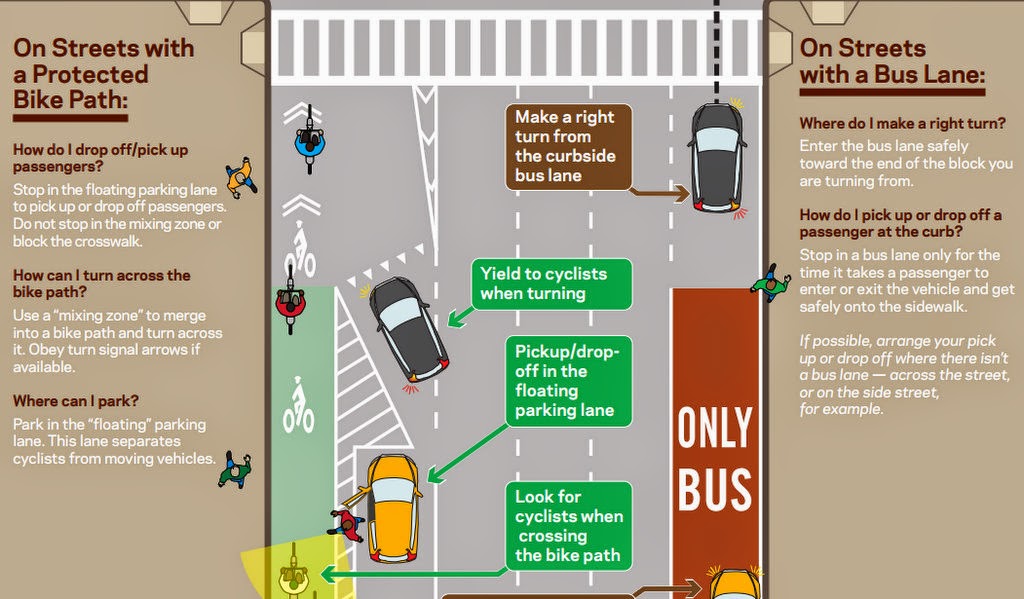
In NYC, the DOT has declared the left turn mixing zone as the default treatment for a protected lane. In the examples provided, bike lanes are continuous on the left side of the one way streets and the left turn is added with yield markings for the vehicles.
Average progression speeds and the speed limits of the one ways are 30 MPH, (the Vision Zero goal is to reduce to 25 MPH).
Heavy turning >150 vehicles per hour are considered as a threshold for when to provide a protected movement for the left turn. The City likes the protected pedestrian movement that the left turn movement provides (separating turns from the pedestrian WALK indication).

New York City doesn't use vehicle detection, so there's impacts associated with the left turn every cycle.
Bicycle volumes are not explicitly considered as a part of their consideration for the control strategy, which while good policy may be something that the engineering community may struggle with in terms of warrants.

The factors they consider for the design of the facilities include:

  • Yield teeth
  • Watch for turning vehicles
  • non-MUTCD sign for Yielding to bicycles 

There is a flyer they have used to describe the intended outcome on the street.

It seems a simple opportunity to is reduce the signal timing progression speed would be likely to improve yielding.

Sunday, June 8, 2014

Invisible Urbanism - 7 ideas from Portland

At CNU22, the authors of tactical urbanism got awards for their smart presentation of ideas that encourage urban spaces. Since hearing the term, I have thought that some of our signals work is similar, with distinct benefits for promoting urban form and multimodal travel.

1. Signal timing for speeds lower than allowed or signed
2. Pedestrian push buttons that shift green time (often tied to road diets)
3. Leading pedestrian intervals that provide priority to people walking
4. Maximum green times that limit the traffic that can pass a particular point
5. Signal coordination or lack thereof to prioritize pedestrians
6. Upstream metering with signal timing that stores traffic queues strategically
7. Every other cycle service for traffic calming/reduction purposes

Monday, June 2, 2014

What we need to move Transportation forward

I read a post on advocacy and had the following follow up thoughts. It took me way back to my neighborhood activist days. A trip down memory lane can be good to reenergize some of my hopes and dreams for Portland!
The original post is here: http://bikeportland.org/2014/06/02/outside-bike-box-four-ways-portlands-bike-believers-can-connect-city-106754#more-106754
I felt like the use of the term “advocate” is comparable to Jonathan’s thoughts on the term “cyclist”. So with that as a thesis, may I suggest we define what being an “advocate” means?
Perhaps some of the readers even thought: I am not an advocate…. That’s staff at the BTA or someone that is paid to do that… And yes, the BTA & 1000 Friends are very important advocacy groups, whose employees are advocates, but their voice and presence alone is not going to allow us to reach the aspirational future talked about here. If you’re still reading, let me suggest to you, that you are an advocate! Being informed is an important first step, but reading BP alone is not moving the needle (sorry Jonathan) at the pace discussed. So, what’s next? Let me suggest that before one can be an effective advocate, we have to be a neighbor.
Having been active in the City of Milwaukie as a neighborhood Chair and on the city’s Budget Committee nearly 10 years ago now, I learned a bit about who City Council considered trusted advocates. One of my many lessons was that my credibility at the neighborhood level was not high even if I was the “expert” on transportation (in my day job). Experts are not always effective advocates of course but that’s another story. Back to my point... 

I found my voice carried further over time, built mostly by being a neighbor who was first a partner on activities like community clean ups, crime watch discussions, etc and it was through the process of service to the community that I gained credibility. With a some credibility, I was able to start having conversations about the future we wanted and how transit played a role in defining what the community needed in order for the residents to get on board and want it to happen. There is a big difference between having a singularly focused conversation on bicycle or (it was transit in my Milwaukie experience) public transportation with strangers that happen to live nearby than people that know what your dog’s name is and how many kids you have.
My 2 cents: go to your local neighborhood meeting, so when there is an opportunity to advocate, you’ll be a neighbor first and an advocate second. If you’re really passionate about change, get more involved. I learned a ton about how a City functioned and tried my best to positively model the change I “advocated” for as a leader in that community.

Wednesday, April 9, 2014

Bicycle Detection Confirmation "Blue" Light

The addition of new equipment in the traffic signal world is not easy. The City has a new section in its special provisions that allow a designer to provide a blue light with the intent to use that as a bicycle detection confirmation light. 

Here's the specific language that is in the traffic signal special provisions:

02925.66 Blue Bicycle Detection Confirmation Light – Provide light that:

Contains two circuits of 23 high intensity 5mm LEDs that can be powered independently or simultaneously.

LEDs employ InGaN die chemistry for blue color.

Have a viewing angle of 30°.

All electronics are enclosed in a liquid tight black ABS plastic housing.

Internal circuit board coated to protect from condensation and corrosion.

Black powder-coated alumimum angle mount.

Shall be designed for operation at 120 V AC, 20 ma per channel.

The power consumption shall be 2.6 W maximum per channel.

Operating temperature range shall be from -40° F to 120° F.

The warranty shall be three (3) years or more.

(Use the following lead-in paragraph and subsection .68 on projects when new vehicle signals or new pedestrian signals are required.  Check with Signal Designer before using.)