Showing posts with label Blogs. Show all posts

Tuesday, January 10, 2012

Green Wave Signal Timing in Copenhagen with Transit

A great conversation with a consultant who is working on modifying the Green Wave signal timing to incorporate transit priority measures that will reduce delay for buses. In describing the two Green Wave projects we have implemented in Portland outside of downtown (which is all timed for human scale speeds) we discussed the relative importance of certainty associated with the signal timing and the practical implementation issues associated with what you cannot at the intersectionof two green waves. Our experience in Portland is a little difference because our Green Waves are on one way couplets, which makes the progression issue less of an issue in the opposite direction.

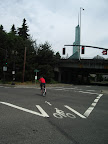
From One Greenwave unofficially starts at the Bike Signal at Interstate & Oregon
My experience in Copenhagen was fantastic on their green waves. It was also very necessary to facilitate the movement of people with their impressive bike mode split nearing 40% for people on bikes. The impetus for reduced bus delay is to reduce costs of service. This is also consistent with an argument I consistently made as a consultant... Any public sector employee should want to reduce bus delay since ultimately the investment in transit is a service that if faster is a savings we can all enjoy. It also can reduce pavement wear if buses are not suddenly stopping at the stop bar.

The person I talked to was also very interested in what we've done with VISSIM to assess bicycles and pedestrians. While we've used some of the elements of simulation, I would say we've just scratched the surface related to what can be done. Beyond the simple assessment of adequacy of the facilities, is the quality of the network to support multimodal travel. There are a lot of details we are not ready to assess to fully evaluate tradeoffs between transit, bike, ped, and freight mobility. Things like the use of detection are difficult to weigh without performance measures and a complete assessment for the 24/7 operating conditions we deal. This is not to mention the maintenance issues associated with the decision of the engineers.

Finally, we discussed detection technology, which is consistent with several posts and a recent inquiry from the Oregonian, BikePortland, and Alta about some work that was done in Pleasonton, CA.

Monday, January 9, 2012

Aren't you that Guy on Twitter

My wife went to a dinner party last night and came back with chuckling at my online presence preceding her. She was talking with a woman that follows me on Twitter and that's how the conversation started for her.

I got that last month at the Bike Gallery, the bike shop that I go when I am not at the neighborhood shop.

So, this post is for those of you reading the blog. Do you follow me on Twitter? Why am I doing this? Partly it goes back to something I read in the book: Better: A Surgeon's Notes on Performance.


A previous blog post focused on this, but he talked specifically about how you improve as a person, a researcher, a surgeon is that you write things down and share them. I believe this is true and when I travelled for work I read a lot and made notes about transportation policy. I was constantly scribbling in the books thinking through what I would do if I was in charge of the transportation system. What are the decisions that I would make? How would things be different? How would the policies better match the communities needs? It's something that I am trying to continue in this current day, as my job becomes less about writing a report, but more about making good decisions based on the political, technical, and financial realities that we face.

Sort of a strange retrospective blog post, but it is still close to the New Year, so it is within the time when you can still reflect on a year gone by, right?

The Great Reset Pins Fault on the Finance Sector

It's great when a book highlights the importance of engineers. Even the president gets into the act when Richard Florida quotes him as saying:

"We don't want every single college grad with mathematical aptitude to become a derivatives trader. We want some of them to go into engineering....

I like this graphic by Carl Richards. It is simple, but the essence of the book.


Kurt Andersen talks about a reset in our values and the rise of new frugality Have to follow up on the Colbert Nation video of him.

There's more bashing of the finance sector in the Chapter when he cites NYU economist Nouriel Roubini, "When you have more financial engineers than computer engineers, you know that the brightest minds have gone into something where the margin was excessive."

On the same page, he cites the blog of Michael Mandel, chief economist for Business Week. Mandel charges the decline of high tech trade and notes that "such weak performance in tech innovation paved the way for the financial bubble and ultimately the economic collapse"

"Beacause the financial sector cares almost exclusively about high accounting yields and 'profits', it misallocates capital away from firms and entrepreneurs that could best improve the real economy (e.g. by producing innovative goods through research).

Searching for images of The Great Reset, I also came across this Q&A from the South Florida Business Journal. I think he sugar coats his responses for them somewhat, but that's probably good to sell books.


He puts a pitch in for rail, which I find funny in sprawl ladened South Florida, I guess it depends on where and how, but transit in Florida has its challenges.

Tuesday, October 18, 2011

Pas Pa Blinde Vinkler: Watch the Blind Spot

Looking for a few examples of a Watch the Blind Spot Caution sign and came across the following on the Google machine today.....

Danish Description with nice graphic
http://www.trygtransport.dk/Default.aspx?MenuID=189
Anti-Dooring Campaign
http://www.keirinberlin.de/?p=469
Campaign for Blind Spot awareness.
http://www.treehugger.com/files/2010/08/no-excuses-for-truck-blind-spots.php

Thursday, October 13, 2011

Roads Going High Tech... and Bicycle Lanes Too

Today's blog from the Secretary of Transportation describes roads going high tech. At yesterdays, TransPort meeting (the Intelligent Transportation Systems Subcomittee of Metro's TPAC) we learned about how the Oregon DOT is going to implement some queue warning signs and additional technology to highlight where highway traffic is stopped and to reduce the speed limit accordingly. It's an exciting development for improving safety and improving our highways (specifically Highway 217 and ) as we seek to do more with our existing infrastructure. This specifically should reduce the potential of wasting capacity that can be restored if motorists are aware of the change. One can debate the extent of the improvements, but putting information in the hands of engineers can yield societal benefits. 

Not to be outdone, we're working to pull together information on bike lanes in a similar fashion. The link below shares where the map is and the progress on where we're counting and monitoring use of the system.


http://maps.google.com/maps/ms?ie=UTF8&oe=UTF8&msa=0&msid=201784094409028558690.0004a3e54739207228bb4

UPDATED: I recieved a comment about how we're detecting bikes and that's found here: http://koonceportland.blogspot.com/2011/09/automated-bicycle-counting.html

Thursday, July 14, 2011

PSU Delft Experience highlights

Taking the students on this adventure was a great experience. The program achieved its objective of presenting an introduction into transportation engineering applications in the European context. It built on earlier courses with a special emphasis on differences between U.S. and Dutch standards. The course curriculum featured material that shows the contrast between engineering principles and policies focusing on the standards presented in both the Manual of Uniform Traffic Control Devices and the Highway Capacity Manual. More on the PSU website:

The last full day in Delft is marked with heavy rains and wind that will soak cyclists to the core on even the shortest trips. The woman helping me check out of the place I was staying chalked it up to climate change. Climate change is a serious issue for the Dutch considering that a good percentage of them live below sea level. It's going to rain 55 mm today, just over 2 inches.

I am pleased with the rain because it is giving me a chance to catch up on the students' projects and blog posts.

So here's my Top 5 things that happened on the trip (not in rank order, sorry Brian).

1. Jane Jacobs and her Influence - How European Cities Have Social Networks (no not Facebook)
My favorite post to date was a psuedo assignment related to the book I assigned for the class: Death and Life of American Cities by Jane Jacobs. Brian Davis provided this insightful blast related to how communities can be organized to provide social support. It's not something I ever learned in a transportation engineering course, but creating a transportation system that allows a place to play seems as important as any effort I would produce in my profession. Recognizing the importance of a local community is key to the success of city planning. The density of the City allows this easily in Delft, but I wonder if the combination of the Farmers Market, local businesses, and interactions surrounding Llewllyn Elementary will contribute to the sort of community that will make Sellwood like this.

2. Education of the Future Users of the Transportation System
I really enjoyed the lectures that were part of the program. I learned a lot that I am looking forward to taking back to the City of Portland to apply in our community. One of the most important elements in the Netherlands is their education of future users of the transportation system. It is mandatory that each student take a test on navigating the City by bicycle in the 7th grade. This is all part of the sustainable safety program. They get police involved during the test and the students go through a course that is on city streets. This is after a detailed program on an off-street course.

3. It's All About the Bike (in Urban Planning)

It's often debated of whether there is a bike culture here. I would argue there is, yet it is not a subculture. Everyone has a bicycle. Most use it on occasion which results in them appreciating the vulnerability you feel when one is cycling. This results in a fairly courteous driving population overall and everyone concerned with the safety of each other. They also appreciate the importance of mobility, so the streets carefully discriminate between those that are for cars and freight and ones that are community oriented. They have support for the bike oriented streets because most people cycle. The City of Houten was an extreme example for making it irresistible to cycle to most destinations as highlighted in Sam's post on the community. Kirk and Pam from the class have also done an amazing report that shows some of the bike vs. car routing. Kirk summarized his visit with some more pictures. We also saw the ring road that seemed to work really well for freight and other traffic movements that were longer than just a few miles.

4. What's Wrong with the U.S. - Getting the Little Things Right

I borrowed the last part of the title from Marc Schlossberg Most of the concepts common in the Netherlands are considered radical in the U.S. It seems that working with some of the principles will take time but that incorporating small items like bicycle signal heads that are 10 cm are worth moving the industry towards design at a human scale. It is also clear from this trip that many of the things I have been introducing at the City are consistent with practice here. It is very interesting to consider how the public and the press will take to these ideas. The Portland Mercury followed some of the work here, but they are also the newspaper that post the Pedalpalooza schedule (not exactly on the coffee table of every home in Portland).


Traffic Signal Timing for Cyclists from Peter Koonce on Vimeo.


Here's another one that we did for Broadway/Williams. This is important for the Broadway bicycle traffic that we're trying to make safer. There's a slight tradeoff currently for motorist traffic that we will improve when we make the modification at Victoria associated with the streetcar.

5. Creating the Transportation Leaders of the Future

Lastly, I had a great time getting to know the students of PSU, Peter Furth, and Tom Bertulis. Their energy and excitement about the future of transportation was an inspiration during the trip.

So, in all a great experience. Now, it will be great if it will just stop raining.
Sunday, July 10, 2011

Bicycle Countdown Signal - Time to Green

The bicycle signal countdown timer in Amsterdam, a video can be found here and one in Delft here.
The following is an example of a Countdown to green indication for a bicycle signal in Amsterdam.

The exact time is not provided, but a Wacht message with the circular display that reduces the number of LEDs.

This is similar to the Japanese (sand in the hour glass concept). My host told me that studies have shown that the addition of this signal head has improved compliance. It was not clear from our conversation whether the data collected was from a statistically significant sample.

After uploading this I found a blog post or two about these installations.

In particular, the blog highlights two important concepts from the Dutch designs:
"Traffic light cycle times for cyclists are short. This leads to a low average delay for cyclists at these points, often lower than the average delay for drivers. This increases the competitive advantage of bikes over cars.

Permeability for cyclists. In both cases in these videos, we're crossing in a direction where motorists can't also drive, meaning that cyclists get more direct routes. Again, a competitive advantage for bikes over cars."

This is the one from Amsterdam.


Posted by Picasa

Sunday, June 26, 2011

Left Turn Bicycle Signal in Copenhagen


There is clearly a social contract between engineers and the public that chooses to ride a bicycle through traffic signals that we design. As a designer, you try to make the indications as clear and unambiguous as possible and there is a certain amount of consideration for what the expectation is for a reasonable person to understand. I think this bicycle signal displays meets that criteria. The display is inline with the cyclist maneuver at the intersection. It is a delineated movement with striping on the pavement.

One might argue that it might be a little unclear at night, but I would take that arguement and in this instance it isn't reasonable to assume one should be able to make a left turn from the right lane. This sort of situation wouldn't preclude you from taking the lane and making the left turn, although it could be argued that the signal timing should be set up to insure that the arrivals of the motor vehicles occurred (faster speeds) followed by the bicycle traffic (from the upstream intersection).

I am blogging about bicycle traffic signals and I stop and wonder am I the only one that is thinking about this. Well, luckily I caught the following this evening from the Copenhagenize.com blog on traffic signals in Barcelona.
Posted by Picasa

Thursday, March 10, 2011

Transformative Leadership in Transportation

The National Bike Summit seems to be the nexus of bike advocacy, industry, and political leadership. For as much as I am not sure the bicycle community has a voice equal to transit, highways, and others in transportation (because of the low mode split), I am always impressed with how it is covered by BikePortland.org and others in the blogosphere. 

The link (and excerpts) was appreciated because it includes a couple of transformative leaders in transportation. The session included Earl Blumenauer who is arguably the most important person at the federal level (for both bikes and streetcars) and the most exciting leader at the municipal level in Janette Sadik Khan, who is moving NYC forward with a pace that is impressive. 

I used to think that the facilities were the most important element of transforming transportation, but the more I am involved and thinking about it, the more I think it is one part facilities and an equal effort on the softer side of the issue, exposing people to being on their bikes. I started from watching my father commuting by bus, figuring out he could get there faster on his bike, followed by him wanting to accomplish distances on his bike as a part of his life's goals, and then ending with an awareness of how cycling can transform his family and the children, making them healthier, wealthier, and wiser? Okay, the wisdom stuff is tough to come by, but I agree with Blumenauer when he suggests:

“It’s something that speaks to every single item on the front page of our newspapers: Oil instability in the Middle East, health problems, congestion,” he said. “Everybody on a bike is somebody who is not in front of you in a car, competing for a parking space.”

Making the shift from an expensive transportation system built around the automobile to a more efficient network that accommodates all users may be good logic, but it’s also a leap of thought. “The pivot point is not easy,” Blumenauer acknowledged. “We have habits and politics and mindsets that are entrenched.”

I had a good time today spreading the news with a class at Portland State today. I spoke about the importance of bicycle, pedestrians, transit, and freight movement at traffic signals to a class of senior civil engineering students. I am not sure I have much of an impact with a two hour presentation on a single day with undergraduates, but perhaps there is something that rings true with them as people and the next time they make a transportation choice, it becomes a subconscious thought that the City wants them to access downtown with a mode that is more efficient to serve by the transportation system.


Sunday, February 27, 2011

Brew to Bikes Book Review

My initial post on this was over at my personal blog at : http://peterkoonce.blogspot.com/2011/01/reading-list.html.

Charles Heying and his cadre of coauthors wrote a nice book and I thought a few of the recommendations are worth commenting on. This raises a question about the future of old school media and the popularity of books as we increase the amount of electronic content in the world. The nice thing about reading a book is you get a significant amount of content from one source. A downside is that it doesn't force you to articulate your thoughts on a particular subject like commenting on a blog would. Media like Bikeportland.org  is such a site where the comments can offer significant insight. The newest radio shows on Oregon Public Broadcasting offer an online format for collecting thoughts and the host brings those into the show to offer perspectives that the generalist host would otherwise have.

Back to one of the recommendations worth noting in the book...

Recommendation #2: Don't let economists design your economic development strategy. Here's the excerpt:

For one, they are trained to use data that comes from sources that were design in an industrial economy, like gross domestic product. They focus things like growth and jobs and old school terminology. "things like environmental impacts are described as externalities, as if the economy operates in some abstract world and its connection to the physical world is tangential, even accidental. Pollution and resource depletion seem to come as a surprise to economists, something akin to collateral damage.

There are some socialist leanings in this book, but having read the book "Confessions of an Economic Hitman" among other titles, I appreciate some of these critiques.

Reading the first review on Amazon, it was funny to see that the commenter was from Austin, TX a City where the "Keep (insert City name here) Weird" slogan started. Essentially, I see that sort of a movement as a keep it local concept, an effort to preserve the uniqueness of a community. I don't believe Weird is the right moniker, but it's something that one can hang your hat on (whether it be of a cowboy or bicycle messenger variety).

Saturday, February 19, 2011

Visit to Seattle to Discuss Bicycle Signals

I was invited up to Seattle to present to a group of engineers, planners, and architects from the City of Seattle, SvR Design and the Cascade Bicycle Club.

I was excited about the chance to share some of the work we're doing, because I find it forces me to reflect on the work we're doing and the presentations always stimulate discussion and in many cases ideas that I hadn't thought of. You can also get a pretty good sense from the audience when we're doing innovative things. Not just innovation for the sake of innovation, but with the intent of improving conditions.

The biggest chalenge for the engineers I spoke with is believing the build it and they will come concept. One of the engineers asked specifically how we can spend the money for detection for bikes when there are only a few of them using the facility. It's clear from the question that the City's vision hasn't been shared and the link to sustainibility hasn't been made. I feel strongly that I am serving the City and our mayor. I also happen to agree with the goals, the mode split targets, the intent of our infrastructure spending. Yet, even if I didn't I think I could make the argument with whatever policy it is that there are specific expenditures that would make the signals and street lighting better and meet my interest in sustainability.

The argument for transit priority that I would make is that the costs for transit exist and as a taxpayer, I want to reduce the costs to society of operating the transit vehicles. With street lighting, an investment in new fixtures would reduce long-term electricity costs and the coal that's burned in Boardman (Oregon's favorite coal planet).

There are obvious equity issues associated with pedestrian investments and we're able to make those investments as the requests come in because we prioritize providing access for all users.

But back to Seattle! They have been doing some great things as of late as indicated in the City's Blog. The trip to Seattle was quick with less than 3 hours in the City. I would have liked to have a chance to spend more time and have more a of a chance to learn about what they're doing as opposed to being the presenter, but that's for another time. The ITE Quad meeting is coming up in April.
Posted by Picasa

Wednesday, February 16, 2011

Peter Koonce Mention on Streetsblog

The link name doesn't jive with my mention in the blog post, but alas it was fun to come across this on a recent google search and archive the mention.

Thursday, February 10, 2011

Bike Signal Debate in Salem

I visited our state capital to testify in front of the Senate regarding SB 130 which would add a bicycle signal into the Oregon Vehicle Code. This is important in that it would allow engineers to consider using the display in cases where if applied would reduce confusion regarding the control of the right-of-way. It seems to be moving forward throughout the process and I am hopeful that this step will be one that makes our transportation system safer.

http://bikeportland.org/2011/02/01/pbot-in-salem-to-testify-in-support-of-bicycle-signal-bill-47099#more-47099

Wednesday, October 20, 2010

Baltimore City Response to Citizen Inquiry

I came across this letter from the City of Baltimore via Twitter. The City signals staff that I worked with (the transit agency was my client mostly), was pretty focused on moving cars. So, back then, I wouldn't have expected the mention of transit in a response about signal timing. It was a pleasant surprise, or is it greenwashing.

Sunday, May 2, 2010

Ray LaHood is my hero

There was a good amount of reservation in Portland following Ray LaHood's appointment as USDOT czar. There was talk of Earl Blumenauer serving in this position, so everyone was very excited about this and for us Oregonian's, a guy from IL was not our cup of tea considering how different the City has been then mainstream U.S. Fortunately, Ray has stepped in and become a tour de force for responsible transportation. His speech at the Bike Summit was impressive and his argument for freight related to bikes was epic. Here's some of the dialogue summarized on BikePortland.

Saturday, January 30, 2010

Introducing the Bureau of Transportation's New Signals and Street Lighting Manager

Posted on the Mayor's Blog, but reposted for fun...

Greetings Portland,

My name is Peter Koonce and I am the new manager of the Signals and Street Lighting Division of the Portland Bureau of Transportation. It is my job to keep the traffic signals going green, yellow, red (in that order) and the street lights brightening your commute. As a native of Portland and graduate of Benson Tech, I am excited about contributing to our community by serving the City of Portland in this new role. I am fortunate to find myself with the opportunity to help transform the transportation system into a smarter, more efficient system that reflects the needs of the most sustainable city in the country. Our emphasis will be on building a 21st century transportation system that recognizes the need to move people and goods safely and efficiently.

I joined PBOT after serving the City and other public agencies across the country in private practice with Kittelson & Associates, Inc. My experiences have made me appreciate the uniqueness of our community and the leadership Portland provides for the country. I am especially interested in responding to the challenge of prioritizing our investments and implementing strategies consistent with local policies that address the issues of effective mobility, community development, climate change and expansion of our transportation choices. As a regular bike commuter and long-time bus rider, I am committed to improving transportation for these important customers as well.

During my first month at the bureau, I have experienced small successes I look forward to building on in the coming years. By working closely with our regional partners and advocacy groups – such as TriMet, Metro, Portland State University, the Oregon Department of Transportation, the Bicycle Transportation Alliance and the Willamette Pedestrian Coalition – to improve our community, the Portland Bureau of Transportation and I will work diligently to make Portland a model city for livability.

Sincerely,

Peter Koonce

Thursday, January 21, 2010

Blogs on Transportation

There are some great blogs that I peruse from time to time that I thought I would put a note about. BikePortland.org is my favorite and I do like Portland Transport. BikePortland is a great source of information, but the past couple of days I have been enjoying GreaterGreaterWashington which is very pleasing visually and has good information as well.