I thought I would note a few lessons learned as I go about the TRB Annual Meeting. I have been carefully noting my twitter posts with the requisite hashtag #TRBAM. Sort of like microblogging, it is better than drifting off to sleep during a session (I have never had that problem). I was scheduled three presentations for Sunday, which was the maximum recommended. It's a bit of a crazy schedule, but my love for transportation is that wacky. Luckily, the first two were NACTO Bike Guide presentations and they were elements that I had covered before, so it was not as difficult to present the information there as it would be for a brand new topic. The third presentation was a quick summary of transit signal priority and its link to Connected Vehicle Technology for the Intelligent Transportation Systems (ITS) Public Transit Committee.
Attendance at TRB is something that ages well. Part of the greatness of the meeting is the network of associates you gain after 15 years of consistent attendance. I find by just being here I refocus the efforts I have had and learn so much just by having short conversations. The presentations are a significant effort to organize ones thoughts into a coherent message when you get back home. At least I hope the messages are coherent.
In this Public Transit session, it is relevant to Automatic Vehicle Location (AVL), which might be worthwhile for managing staff at PBOT. There is currently discussion about some small scale efforts to control fleets and even at a very small effort. At PBOT, we've been talking about improving our timesheets and moving toward electronic copies as opposed the five versions of paper and pencil that the staff currently have to do every single day to get paid.
Sunday, January 22, 2012

Saturday, January 21, 2012
Traffic Signal Systems Signal Timing Subcomittee Meeting Agenda
Monday, January 23, 2012, 11:00am-12:00pm, Marriott, Park Tower Suite 8222
Traffic Signal Systems Signal Timing Subcommittee, AHB25
Peter Koonce, City of Portland, presiding
AGENDA
1. What’s New in Signal Timing – 2 minute Teasers
1.1. Connected Vehicle – Green Driver Ap – Peter Koonce
1.2. Signal Phase and Timing – FHWA – Deborah Curtis
1.3. Protected Permitted Left Turns – Kittelson & Associates, Inc. – Shaun Quayle
1.4. Next Generation Signal Control – Virginia Tech - Milos Mladenovic
1.5. Highway Capacity Manual 2010 – Who is Using it?
1.6. Environmental Performance - Peter Koonce
2. Update on Completed Research – Selected Presentations – 20 min
2.1. NCHRP 3-90: Oversaturated Conditions - Doug Gettman, Kimley Horn – 10 min
2.2. Adaptive Signal Systems Engineering Document – Paul Olson, FHWA – 10 min
Other Projects without Presentations Scheduled for Our Subcommittee
2.3. NCHRP 3-97: Rick Dowling, Dowling Associates
2.4. NCHRP 3-95: Hugh McGee, VHB
2.5. Adaptive Traffic Control Systems: Domestic and Foreign State of Practice
3. Ongoing Research – 25 min
3.1. NCHRP 3-103 – Update of Signal Timing Manual – Tom Urbanik, Kittelson – 15 min
3.2. NSF project 1130936, "Self-Organizing Traffic Signals" - Peter Furth, Northeastern University - 10 min
Traffic Signal Systems Signal Timing Subcommittee, AHB25
Peter Koonce, City of Portland, presiding
AGENDA
1. What’s New in Signal Timing – 2 minute Teasers
1.1. Connected Vehicle – Green Driver Ap – Peter Koonce

1.2. Signal Phase and Timing – FHWA – Deborah Curtis
1.3. Protected Permitted Left Turns – Kittelson & Associates, Inc. – Shaun Quayle
1.4. Next Generation Signal Control – Virginia Tech - Milos Mladenovic
1.5. Highway Capacity Manual 2010 – Who is Using it?
1.6. Environmental Performance - Peter Koonce
2. Update on Completed Research – Selected Presentations – 20 min
2.1. NCHRP 3-90: Oversaturated Conditions - Doug Gettman, Kimley Horn – 10 min
2.2. Adaptive Signal Systems Engineering Document – Paul Olson, FHWA – 10 min
Other Projects without Presentations Scheduled for Our Subcommittee
2.3. NCHRP 3-97: Rick Dowling, Dowling Associates
2.4. NCHRP 3-95: Hugh McGee, VHB
2.5. Adaptive Traffic Control Systems: Domestic and Foreign State of Practice
3. Ongoing Research – 25 min
3.1. NCHRP 3-103 – Update of Signal Timing Manual – Tom Urbanik, Kittelson – 15 min
3.2. NSF project 1130936, "Self-Organizing Traffic Signals" - Peter Furth, Northeastern University - 10 min
Friday, January 20, 2012
Bike Signals Presentation at 2012 #TRBAM
 |
| The CROW Manual is a great resource for bicycle design. |

There are a wide variety of elements that we have used on the nine bicycle signals that we have built. The map that I have been using to inventory the system and planned indications is helpful to keep straight all of the work that is in the works.
View Portland's Bicycle Signals in a larger map
The NACTO Bike Guide presentations were very good overall. I learned quite a few things and did a bit of binge tweeting with nine tweets in about 4 hours.
Preparation for my presentation caused me to review the Guide in more depth and I found a few things that I disagree with in the signals portion, most notably the Clearance interval issue, which is something that's an ongoing debate at the Institute of Transportation Engineers and National Cooperative Highway Research Program efforts that have been worked on by VHB and Wayne State University. It's a project that originally proposed an arbitrary increase in yellow time for all cases where people on bicycles are present. All in the name of safety. I contend (consistent with the research) that the longer you make a clearance interval the more people will learn the constraints of the system and they will make decisions based on the known risk factors. The higher the clearance interval (yellow and all red) the higher likelihood for variable behavior. Higher speeds contribute to this issue and it falls back to the fundamental concept for how speeds are set in the U.S.
Thursday, January 12, 2012
Junction design the Dutch - cycle friendly - way
Discussion at PBOT today and I couldn't find the following video. It's unclear whether this would meet our accessibility requirements and I haven't heard of another agency that has implemented a signal like this.
Wednesday, January 11, 2012
Traffic Signal System of Tomorrow
Today at our regional meeting of the transportation operations staff, we discussed the operation of a future traffic signal system that advances beyond mid 1990s software programming. The system would have a graphical user interface that matches the functionalities of Google maps and the system would send text messages based on predefined criteria that alert us to problems such as the signal failing due to a loss of power or a conflicting movement. These are very basic things that we haven't set up to my knowledge. We use the public to tell us when signals are in red flash (and they are pretty good at it too).
We are not so good at knowing if the detection has failed or if the bus is calling for priority like we had set it up to do.
As we discussed that, I came back to reality recognizing that the budgets are tight and getting tighter. Yet there is an increasing need to make decisions based on data and to be data driven. The cross roads for this is a continuous investment in technology and communication that will have our systems report about how well they are operating and if there is some maintenance function that is necessary. The logical next step would be an expert system that prioritizes functions and action for an agency.
Tuesday, January 10, 2012
Green Wave Signal Timing in Copenhagen with Transit
A great conversation with a consultant who is working on modifying the Green Wave signal timing to incorporate transit priority measures that will reduce delay for buses. In describing the two Green Wave projects we have implemented in Portland outside of downtown (which is all timed for human scale speeds) we discussed the relative importance of certainty associated with the signal timing and the practical implementation issues associated with what you cannot at the intersectionof two green waves. Our experience in Portland is a little difference because our Green Waves are on one way couplets, which makes the progression issue less of an issue in the opposite direction.
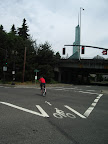 |
| From One Greenwave unofficially starts at the Bike Signal at Interstate & Oregon |
The person I talked to was also very interested in what we've done with VISSIM to assess bicycles and pedestrians. While we've used some of the elements of simulation, I would say we've just scratched the surface related to what can be done. Beyond the simple assessment of adequacy of the facilities, is the quality of the network to support multimodal travel. There are a lot of details we are not ready to assess to fully evaluate tradeoffs between transit, bike, ped, and freight mobility. Things like the use of detection are difficult to weigh without performance measures and a complete assessment for the 24/7 operating conditions we deal. This is not to mention the maintenance issues associated with the decision of the engineers.
Finally, we discussed detection technology, which is consistent with several posts and a recent inquiry from the Oregonian, BikePortland, and Alta about some work that was done in Pleasonton, CA.
Monday, January 9, 2012
Aren't you that Guy on Twitter
My wife went to a dinner party last night and came back with chuckling at my online presence preceding her. She was talking with a woman that follows me on Twitter and that's how the conversation started for her.
I got that last month at the Bike Gallery, the bike shop that I go when I am not at the neighborhood shop.
So, this post is for those of you reading the blog. Do you follow me on Twitter? Why am I doing this? Partly it goes back to something I read in the book: Better: A Surgeon's Notes on Performance.

A previous blog post focused on this, but he talked specifically about how you improve as a person, a researcher, a surgeon is that you write things down and share them. I believe this is true and when I travelled for work I read a lot and made notes about transportation policy. I was constantly scribbling in the books thinking through what I would do if I was in charge of the transportation system. What are the decisions that I would make? How would things be different? How would the policies better match the communities needs? It's something that I am trying to continue in this current day, as my job becomes less about writing a report, but more about making good decisions based on the political, technical, and financial realities that we face.
Sort of a strange retrospective blog post, but it is still close to the New Year, so it is within the time when you can still reflect on a year gone by, right?
I got that last month at the Bike Gallery, the bike shop that I go when I am not at the neighborhood shop.
So, this post is for those of you reading the blog. Do you follow me on Twitter? Why am I doing this? Partly it goes back to something I read in the book: Better: A Surgeon's Notes on Performance.

A previous blog post focused on this, but he talked specifically about how you improve as a person, a researcher, a surgeon is that you write things down and share them. I believe this is true and when I travelled for work I read a lot and made notes about transportation policy. I was constantly scribbling in the books thinking through what I would do if I was in charge of the transportation system. What are the decisions that I would make? How would things be different? How would the policies better match the communities needs? It's something that I am trying to continue in this current day, as my job becomes less about writing a report, but more about making good decisions based on the political, technical, and financial realities that we face.
Sort of a strange retrospective blog post, but it is still close to the New Year, so it is within the time when you can still reflect on a year gone by, right?
Subscribe to:
Posts (Atom)