Thursday, January 12, 2012
Junction design the Dutch - cycle friendly - way

Wednesday, January 11, 2012
Traffic Signal System of Tomorrow
Today at our regional meeting of the transportation operations staff, we discussed the operation of a future traffic signal system that advances beyond mid 1990s software programming. The system would have a graphical user interface that matches the functionalities of Google maps and the system would send text messages based on predefined criteria that alert us to problems such as the signal failing due to a loss of power or a conflicting movement. These are very basic things that we haven't set up to my knowledge. We use the public to tell us when signals are in red flash (and they are pretty good at it too).
We are not so good at knowing if the detection has failed or if the bus is calling for priority like we had set it up to do.
As we discussed that, I came back to reality recognizing that the budgets are tight and getting tighter. Yet there is an increasing need to make decisions based on data and to be data driven. The cross roads for this is a continuous investment in technology and communication that will have our systems report about how well they are operating and if there is some maintenance function that is necessary. The logical next step would be an expert system that prioritizes functions and action for an agency.
Tuesday, January 10, 2012
Green Wave Signal Timing in Copenhagen with Transit
A great conversation with a consultant who is working on modifying the Green Wave signal timing to incorporate transit priority measures that will reduce delay for buses. In describing the two Green Wave projects we have implemented in Portland outside of downtown (which is all timed for human scale speeds) we discussed the relative importance of certainty associated with the signal timing and the practical implementation issues associated with what you cannot at the intersectionof two green waves. Our experience in Portland is a little difference because our Green Waves are on one way couplets, which makes the progression issue less of an issue in the opposite direction.
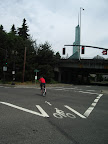 |
| From One Greenwave unofficially starts at the Bike Signal at Interstate & Oregon |
The person I talked to was also very interested in what we've done with VISSIM to assess bicycles and pedestrians. While we've used some of the elements of simulation, I would say we've just scratched the surface related to what can be done. Beyond the simple assessment of adequacy of the facilities, is the quality of the network to support multimodal travel. There are a lot of details we are not ready to assess to fully evaluate tradeoffs between transit, bike, ped, and freight mobility. Things like the use of detection are difficult to weigh without performance measures and a complete assessment for the 24/7 operating conditions we deal. This is not to mention the maintenance issues associated with the decision of the engineers.
Finally, we discussed detection technology, which is consistent with several posts and a recent inquiry from the Oregonian, BikePortland, and Alta about some work that was done in Pleasonton, CA.
Monday, January 9, 2012
Aren't you that Guy on Twitter
I got that last month at the Bike Gallery, the bike shop that I go when I am not at the neighborhood shop.
So, this post is for those of you reading the blog. Do you follow me on Twitter? Why am I doing this? Partly it goes back to something I read in the book: Better: A Surgeon's Notes on Performance.

A previous blog post focused on this, but he talked specifically about how you improve as a person, a researcher, a surgeon is that you write things down and share them. I believe this is true and when I travelled for work I read a lot and made notes about transportation policy. I was constantly scribbling in the books thinking through what I would do if I was in charge of the transportation system. What are the decisions that I would make? How would things be different? How would the policies better match the communities needs? It's something that I am trying to continue in this current day, as my job becomes less about writing a report, but more about making good decisions based on the political, technical, and financial realities that we face.
Sort of a strange retrospective blog post, but it is still close to the New Year, so it is within the time when you can still reflect on a year gone by, right?
The Great Reset Pins Fault on the Finance Sector
"We don't want every single college grad with mathematical aptitude to become a derivatives trader. We want some of them to go into engineering....
I like this graphic by Carl Richards. It is simple, but the essence of the book.

Kurt Andersen talks about a reset in our values and the rise of new frugality Have to follow up on the Colbert Nation video of him.
There's more bashing of the finance sector in the Chapter when he cites NYU economist Nouriel Roubini, "When you have more financial engineers than computer engineers, you know that the brightest minds have gone into something where the margin was excessive."
On the same page, he cites the blog of Michael Mandel, chief economist for Business Week. Mandel charges the decline of high tech trade and notes that "such weak performance in tech innovation paved the way for the financial bubble and ultimately the economic collapse"
"Beacause the financial sector cares almost exclusively about high accounting yields and 'profits', it misallocates capital away from firms and entrepreneurs that could best improve the real economy (e.g. by producing innovative goods through research).
Searching for images of The Great Reset, I also came across this Q&A from the South Florida Business Journal. I think he sugar coats his responses for them somewhat, but that's probably good to sell books.

He puts a pitch in for rail, which I find funny in sprawl ladened South Florida, I guess it depends on where and how, but transit in Florida has its challenges.
Monday, January 2, 2012
The Great Reset by Richard Florida
A good book so far although it seems like a bunch of small newspaper column articles that have been stitched together by a successful author trying to write another book to satisfy a contract obligation.
That being said there are some good stuff in the book. One takeaway that comes early on in the book is a quote by Paul Romer who said "a crisis being a terrible thing to waste". The author makes the case that we are wasting it by throwing public money at the old economy. He suggests that government spending can't be the solution in the long run because it's simply lacks the resources to generate the enormous level of demand you need to power sustained growth.
Consistent with his other book The Rise of the Creative Class, Mr. Florida writes about transportation and housing, making the land use connection. I found it interesting when he talked about new models of consumption that spur the economy, enabling industry to expand and productivity to improve, thus creating better jobs for workers. This sounds a bit utopian and highly dependent on China for production, which he describes as an issue as well.
He references Jane Jacobs several times in the first few chapters and some of this seems like an update of her work. Peculiar that he has moved to Toronto (just like Jacobs did) after living in Newark, Boston, Washington DC, Pittsburgh, and Detroit.
He has three key attributes that he cites as what makes people happy in their communities and causes them to develop a solid emotional attachment to the place they live.
First, the physical beauty and level of maintenance (great open spaces and parks - Portland, check);
Second, the ease with which people can meet others, make friends, etc (PDX - compact urban form - check)
Third, diversity and open mindedness, acceptance (PDX seems to have all but the great diversity here).
The meeting is next week and I have the book nearly half read after a solid day working on it.