PSU Delft Day 1 by pkoonce99 at Garmin Connect - Details
Monday, July 4, 2011

Sunday, July 3, 2011
Ikea just like any other
 One of the primary reasons to travel is to have new experiences. We're staying next to an Ikea and it makes me reflect back on the one trip I made while working as a consultant for Costco. The trip was back in 2004 or so and I was travelling to Mexico City to review several Costco sites, specifically to identify traffic signal "improvements" or widening actions that were being requested by the local agencies. Most of the recommendations were based on standard American engineering practices, which is to estimate the number of new vehicle trips, assuming worst case conditions and unlimited supply of vehicle parking spaces, traffic capacity for the surrounding street system, and a booming economy. The last issue identified there doesn't fit, but the first two are totally within the local jurisdictions control.
I remember being in the Costco in Mexico City and recognizing everything. The cash register layout, the shelfing, the advertisements as you leave the facility. It was like a little slice of suburban America was shipped south and translated into the Spanish language.
A little more on the experience at the Family Blog.


Small Nearside Bicycle Signal With Directional Indication
Here's a great example of where Amsterdam has expanded the use of the nearside signal to include the arrows. 

Bicycle Traffic at Amstelveenseweg and Theophile de Bockstraat
Another photo showing the bicycles and rollerbladers (not many of those). The people on bicycles quickly went around the rollerbladers. I am wondering if there is good data from Holland on the startup lost time of cyclists.
![]()
 The people on bicycles quickly went around the rollerbladers. I am wondering if there is good data from Holland on the startup lost time of cyclists.
 Here's a picture of the detection at the intersection for that approach. you can see the shark's teeth for the yield, the stop bar, and the bicycle detection.

Bicycle and Pedestrian Indications
Here's another example of a traffic signal for peds and bikes. I learned yesterday that the reason they show a yield sign on the bike signal pole is in case the signal fails it reinforces the control at the intersection is to be yield, similar to our red flash intersection and the instructions that you must stop at a traffic signal that is dark. Several notable things here.
There are pedestrian indications on every single slice of concrete at the intersection. In reality, this is a four stage crossing for pedestrians with a crossing of the bicycle traffic (what would be right turning traffic in the U.S. (on the right of the picture), the traffic coming from the left (just after the yield and bicycle indication), the through traffic and the right turning traffic on the other side. There is a push button detector for cyclists for that second ped crossing.
 |
| The intersection of Amstelveenseweg and Theophile de Bockstraat |
Leading Bicycle Interval
We arrived in Amsterdam and the first thing I did upon arriving is visit the closest traffic signal to our hotel. I was interested to compare the experiences in Denmark with the Dutch practices. This was a minor street connecting with a more significant street adjacent to the Rijksmuseum.  The first thing noticeable about this signal was that the indications for the bicycle are nearside. The second is that there are two separate indications (a large head mounted at around 3 meters) and a 10 cm (4 inches) indication. My guess is that the redundant signal head is used for the same reason we use multiple displays, but can't be sure. The third and most interesting from an operations perspective is the leading bicycle interval. I tried to take as many pictures as I could one after another to guess at how much time the intervals was for the bikes (it was about five seconds based on my camera time stamp). It seems that the reason for a Leading Bicycle Interval (LBI) is that the crosswalk is very large and it would be a nice thing to allow people on bicycles to establish themselves in the intersection across the crosswalk and to make the turn if they were so inclined. This might reduce the potential conflict point at the intersections which you can see just past the crosswalk and out of the shade of the curb tight building. The fourth application which we have used very sparingly in the U.S. is mirrors. In this application, I am guessing it helps freight and other motor vehicles determine if there are pedestrians coming up along the sidewalk and bikes approaching. It's another cue for encouraging the safe movement of traffic. I can already hear the complaints of maintenance staff if we proposed these at intersections.
Assuming that a community only wants to spend so much for a traffic signal (I doubt the Dutch love their signals any more than we do), in the U.S. (and in Portland), I would like to do an assessment of what elements of traffic signals cost us the most money (foundations for signal poles and the mast arm signal poles themselves) and what yields the highest safety benefits. There are distinct costs for traffic signals that require to be mounted over the lane lines and that is a function of the assumed speed of traffic and reaction times and so many human factors issues that it would be very helpful to know the tradeoffs between actually safety elements we design at intersections and their cost. I would be willing to wager a strong cup of coffee at Water Avenue that we could save ourselves a lot of money if we traded the costs of foundations and invested in better detection, marking on the pavement, and maintenance resources.
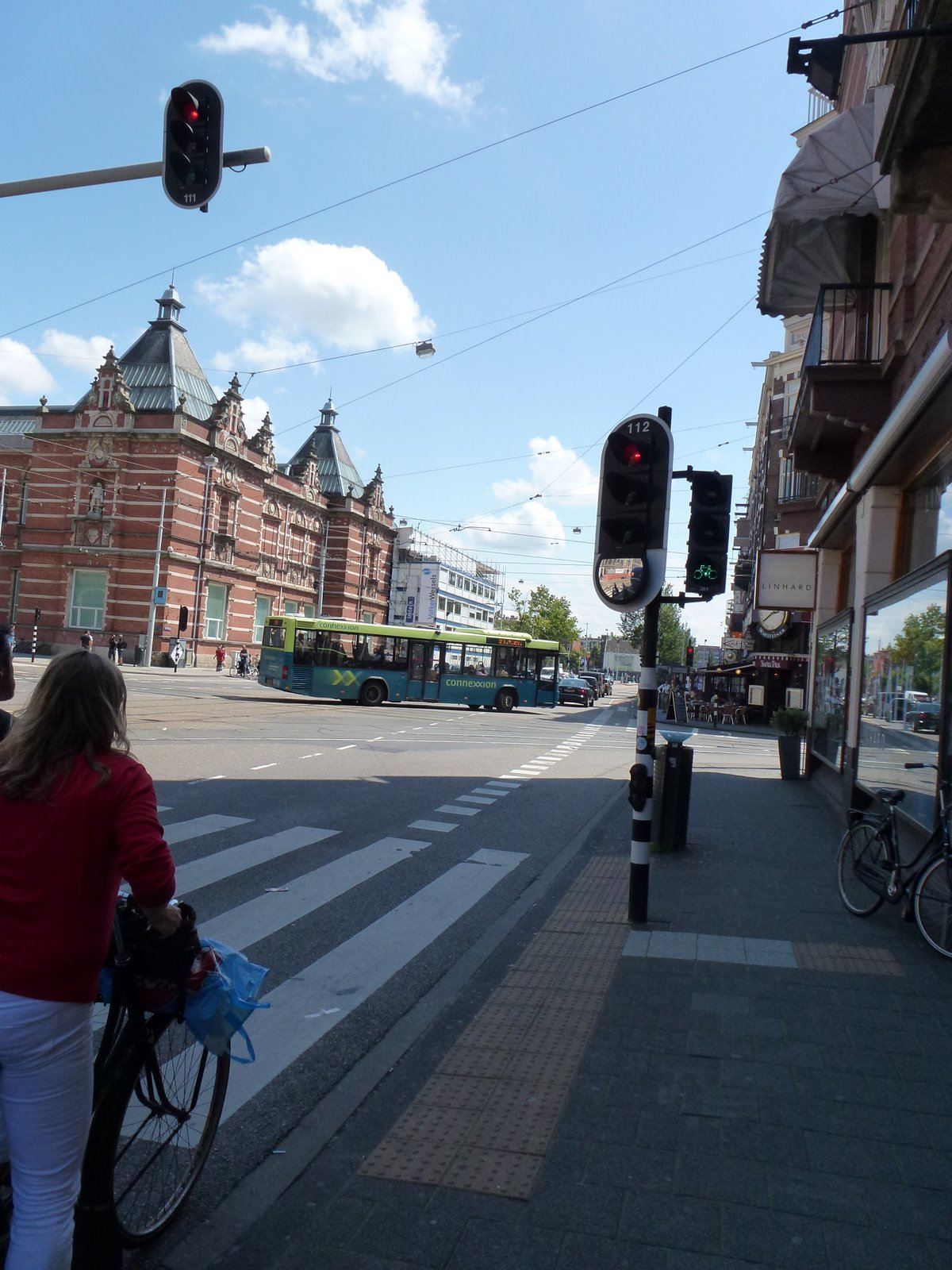 The first thing noticeable about this signal was that the indications for the bicycle are nearside. The second is that there are two separate indications (a large head mounted at around 3 meters) and a 10 cm (4 inches) indication. My guess is that the redundant signal head is used for the same reason we use multiple displays, but can't be sure. The third and most interesting from an operations perspective is the leading bicycle interval. I tried to take as many pictures as I could one after another to guess at how much time the intervals was for the bikes (it was about five seconds based on my camera time stamp). It seems that the reason for a Leading Bicycle Interval (LBI) is that the crosswalk is very large and it would be a nice thing to allow people on bicycles to establish themselves in the intersection across the crosswalk and to make the turn if they were so inclined. This might reduce the potential conflict point at the intersections which you can see just past the crosswalk and out of the shade of the curb tight building. The fourth application which we have used very sparingly in the U.S. is mirrors. In this application, I am guessing it helps freight and other motor vehicles determine if there are pedestrians coming up along the sidewalk and bikes approaching. It's another cue for encouraging the safe movement of traffic. I can already hear the complaints of maintenance staff if we proposed these at intersections.
Assuming that a community only wants to spend so much for a traffic signal (I doubt the Dutch love their signals any more than we do), in the U.S. (and in Portland), I would like to do an assessment of what elements of traffic signals cost us the most money (foundations for signal poles and the mast arm signal poles themselves) and what yields the highest safety benefits. There are distinct costs for traffic signals that require to be mounted over the lane lines and that is a function of the assumed speed of traffic and reaction times and so many human factors issues that it would be very helpful to know the tradeoffs between actually safety elements we design at intersections and their cost. I would be willing to wager a strong cup of coffee at Water Avenue that we could save ourselves a lot of money if we traded the costs of foundations and invested in better detection, marking on the pavement, and maintenance resources.
Tuesday, June 28, 2011
FHWA Report Review: The Role of Management & Operations in Supporting Livability and Sustainability: A Primer
I visited Arlington, VA last year as a part of an FHWA workshop on Transportation System Management & Operations (TSMO) for Livability and Sustainability. An interesting concept, one that very much is consistent with the work my Division is supposed to do and the last blog post I added to the site. On a 30-page document, I had over 65 comments. There were a lot of great ideas and a lot of traditional concepts that you have to green wash to make decision makers feel like they are doing something good for the environment.
The HUD-DOT-EPA Partnership for Sustainable Communities got it right. The Interagency Partnership for Sustainable Communities developed six livability principles to act as a foundation for interagency coordination. The interagency promotion of livability aims to help America’s neighborhoods become "safer, healthier, and more vibrant". The Partnership will encourage the incorporation of livability principles into Federal programs, while better protecting the environment, promoting equitable development, and helping to address the challenges of climate change. Available at http://www.epa.gov/smartgrowth/partnership/index.html
I agree with the following statement from the draft report: "M&O strategies cost-effectively improve transportation system performance. M&O strategies are able to improve the performance of the transportation system at low- to moderate- cost and without requiring significant expansion of the system’s physical capacity."
Livability is a tough term because my definition is much different than someone from Copenhagen's.
 post I added to the site. On a 30-page document, I had over 65 comments. There were a lot of great ideas and a lot of traditional concepts that you have to green wash to make decision makers feel like they are doing something good for the environment.
The HUD-DOT-EPA Partnership for Sustainable Communities got it right. The Interagency Partnership for Sustainable Communities developed six livability principles to act as a foundation for interagency coordination. The interagency promotion of livability aims to help America’s neighborhoods become "safer, healthier, and more vibrant". The Partnership will encourage the incorporation of livability principles into Federal programs, while better protecting the environment, promoting equitable development, and helping to address the challenges of climate change. Available at http://www.epa.gov/smartgrowth/partnership/index.html
I agree with the following statement from the draft report: "M&O strategies cost-effectively improve transportation system performance. M&O strategies are able to improve the performance of the transportation system at low- to moderate- cost and without requiring significant expansion of the system’s physical capacity."
Livability is a tough term because my definition is much different than someone from Copenhagen's.
Subscribe to:
Posts (Atom)